Austin’s Tech Renaissance: How “Silicon Hills” Became a Global Innovation Powerhouse
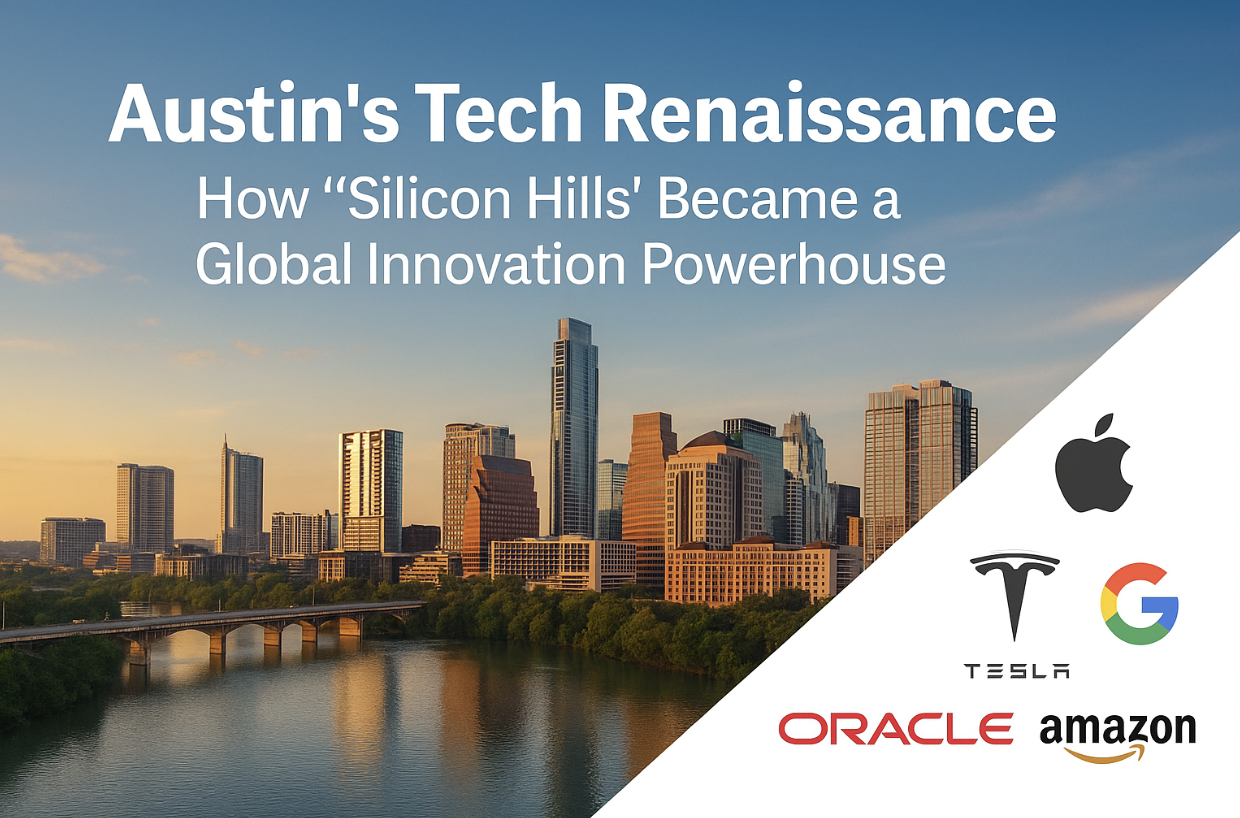
Austin, Texas — once celebrated mostly for its live music, creative soul, and unmistakably quirky charm — has spent the last decade quietly transforming into something much bigger. Today, “Silicon Hills” isn’t just a catchy nickname; it’s a reflection of Austin’s position as one of the world’s fastest-growing tech hubs. Innovation, capital, and talent are converging here in a way that’s reshaping the city’s identity and its economic trajectory.
A big part of Austin’s rise comes from the extraordinary growth of its startup ecosystem. What used to be a scrappy community of dreamers has matured into a launchpad for billion-dollar ambitions. The Austin Technology Council reports that the city’s entrepreneurial scene has expanded more than twelvefold since 2017 — outpacing many traditional tech centers by a wide margin. And 2025 has been a milestone year. Record levels of venture capital are flowing into everything from early-stage founders to hardware pioneers, powering sectors as varied as climate tech, robotics, and semiconductors. Green-energy startups are pushing ahead with new battery-storage solutions and EV infrastructure. Robotics companies like Apptronik and Avride are testing next-generation autonomous machines right on Austin’s streets. And thanks to Austin’s deep engineering talent, chip and hardware innovators are setting up shop to build the future of manufacturing.
But Austin’s story isn’t just about scrappy startups. Major tech players have planted roots here too — Apple, Google, Tesla, Oracle, Amazon, and others now maintain significant footprints across the region. Their interest isn’t accidental. Between the University of Texas feeding the city a growing pipeline of engineers and data scientists, a business climate bolstered by no state income tax, and the lifestyle perks that make Austin so appealing, the city has become a magnet for both companies and the people they want to hire. It's a rare blend: economic opportunity paired with a culture that prizes creativity and quality of life.
That growth has pushed Austin to invest in the infrastructure required to support a modern innovation economy. Opportunity Austin’s latest report highlights that the region now ranks among the top 10 tech hubs in North America, with engineering and digital jobs more than doubling since 2010. Massive projects — like a new $440 million data center rising in Bastrop County — are being built to power the next wave of AI, cloud, and high-performance computing. And across the city, partnerships between universities, corporations, and startups are strengthening research pipelines, workforce development, and commercialization efforts.
One particularly exciting area is green tech. There’s a palpable sense of momentum here as companies work to solve real-world sustainability challenges. Investors are increasingly backing innovators who aim to make renewable energy more efficient and accessible, whether through advanced energy-storage systems, improved EV charging networks, or AI tools that optimize solar and grid performance. Austin isn’t just adopting clean technologies — it’s helping invent them.
Autonomous technology is also taking shape at a rapid clip. With favorable state regulations and a willingness to embrace experimentation, Austin has become a testing ground for robotaxis and delivery robots. Local company Avride is one of several pushing the boundaries of autonomy, while robotics firms more broadly are building systems for logistics, manufacturing, and everyday tasks. It’s the kind of frontier work that positions Austin as a leader in what mobility may look like in the coming decades.
Of course, rapid growth comes with growing pains. The city must work hard to ensure it can sustain this momentum. Retaining highly skilled talent, scaling infrastructure to meet energy and transportation demands, and prioritizing equity so that Austin’s rising prosperity benefits all communities will all be critical challenges. How the city navigates these pressures will influence not only its trajectory, but its character.
Still, Austin’s tech boom carries significance far beyond Central Texas. It shows that the U.S. innovation economy doesn’t have to revolve around a single region anymore. It demonstrates that climate-focused technology can be both scalable and economically viable. And it positions the city as a testing ground for the technologies — and lifestyles — of the future.
In the end, Austin’s tech rise isn’t a fluke or a bubble. It’s the result of intentional alignment: strong universities, smart policy, accessible talent, a diversified ecosystem, and the cultural magnetism that keeps people here once they arrive. For founders, investors, and ambitious professionals, Austin has become much more than an alternative to Silicon Valley. It’s becoming the destination.
Recent Posts






GET MORE INFORMATION