Unlocking More Homes: Why Minimum Lot Size Matters for Affordability in Austin
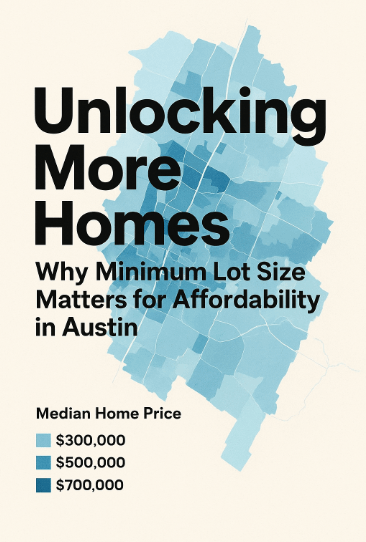
Austin’s housing market is in the spotlight for all the wrong reasons. Median home prices have surged, mortgage rates are still high, and homes affordable to the average resident are increasingly hard to find. In 2023, the median sales price in Austin was $540,000, yet only 5.5% of homes sold for under $300,000—a figure that many first-time buyers can realistically reach. Clearly, something needs to change.
One approach gaining attention is adjusting land-use rules, specifically reducing the minimum lot size for single-family homes. The city’s “HOME Initiative,” Phase II, is exploring just that: shrinking the minimum lot size from 5,750 square feet to as little as 2,500 square feet. But how exactly could smaller lots help?
First, it’s about cost. Smaller lots reduce the land expense per home, which can directly translate to lower prices. Second, it’s about supply. If developers can build more homes on the same piece of land—or subdivide large lots into multiple smaller ones—the total housing supply rises. More supply tends to relieve some of the pressure that drives prices upward.
The report’s findings make this tangible. Land and construction together account for roughly 70–80% of a new home’s price in Austin. By reducing the minimum lot size to around 2,000 square feet, a home that might otherwise sell for $540,000 could drop to approximately $477,000—a savings of nearly $63,000. And if both lot size and home size shrink, the potential savings jump even higher: a $600,000 home could potentially sell for just over $310,000 in a maximal-impact scenario.
On the supply side, the numbers are promising too. If redevelopment and infill development follow the new rules, Austin could see anywhere from 87 to 871 additional homes built per year, depending on how many lots are subdivided. But it’s not an overnight solution. Permitting, construction timelines, and other regulations mean it could take years—or even decades—before the affordability benefits fully materialize.
Why does this matter? For first-time homebuyers, smaller lots can make ownership more attainable. Fewer land costs and smaller homes mean lower price points. For Austin’s economy, a larger supply of housing helps retain teachers, firefighters, young professionals, and retirees—people who might otherwise be priced out. The report explicitly notes that attracting and keeping a diverse workforce requires a “sufficient supply of homes across the price distribution.”
There’s also an equity component. Zoning rules that enforce large lot sizes can limit housing density and lock out more affordable options. Reducing lot size opens the door to smaller homes and more units per acre, helping diversify the housing stock and make neighborhoods more accessible.
Of course, there are caveats. Many existing lots have deed restrictions or other legal limits on subdivision. Builder incentives may not align with smaller lot development—if profitability drops, they may resist change. And paradoxically, land costs could rise if lots become more valuable because they can be split. Permitting and other regulations remain critical levers to ensure these changes actually result in affordable housing.
For homebuyers, this means paying attention. Neighborhoods experiencing policy changes or infill development could be where lower-priced homes emerge. But trade-offs exist: smaller lots often mean smaller yards and less outdoor space.
For policymakers and community advocates, lot size reform is just one piece of a larger puzzle. Streamlining permitting, supporting infill, and incentivizing genuinely affordable housing are essential to making this tool effective. Engaging homeowners, developers, and neighborhood stakeholders early can also help address concerns about density, infrastructure, and community character.
In the end, reducing minimum lot size isn’t a silver bullet, but it’s a meaningful lever. By affecting both land cost and housing supply, Austin has the potential to make homeownership more attainable. The estimated savings—$60,000 or more per home—are significant, even if the timeline is long. For educators, first responders, young professionals, and retirees feeling squeezed, these changes could provide a pathway to the homes they need.
Recent Posts






GET MORE INFORMATION