Meet Austin’s Emerging Billionaires: Profiles of Power and Innovation
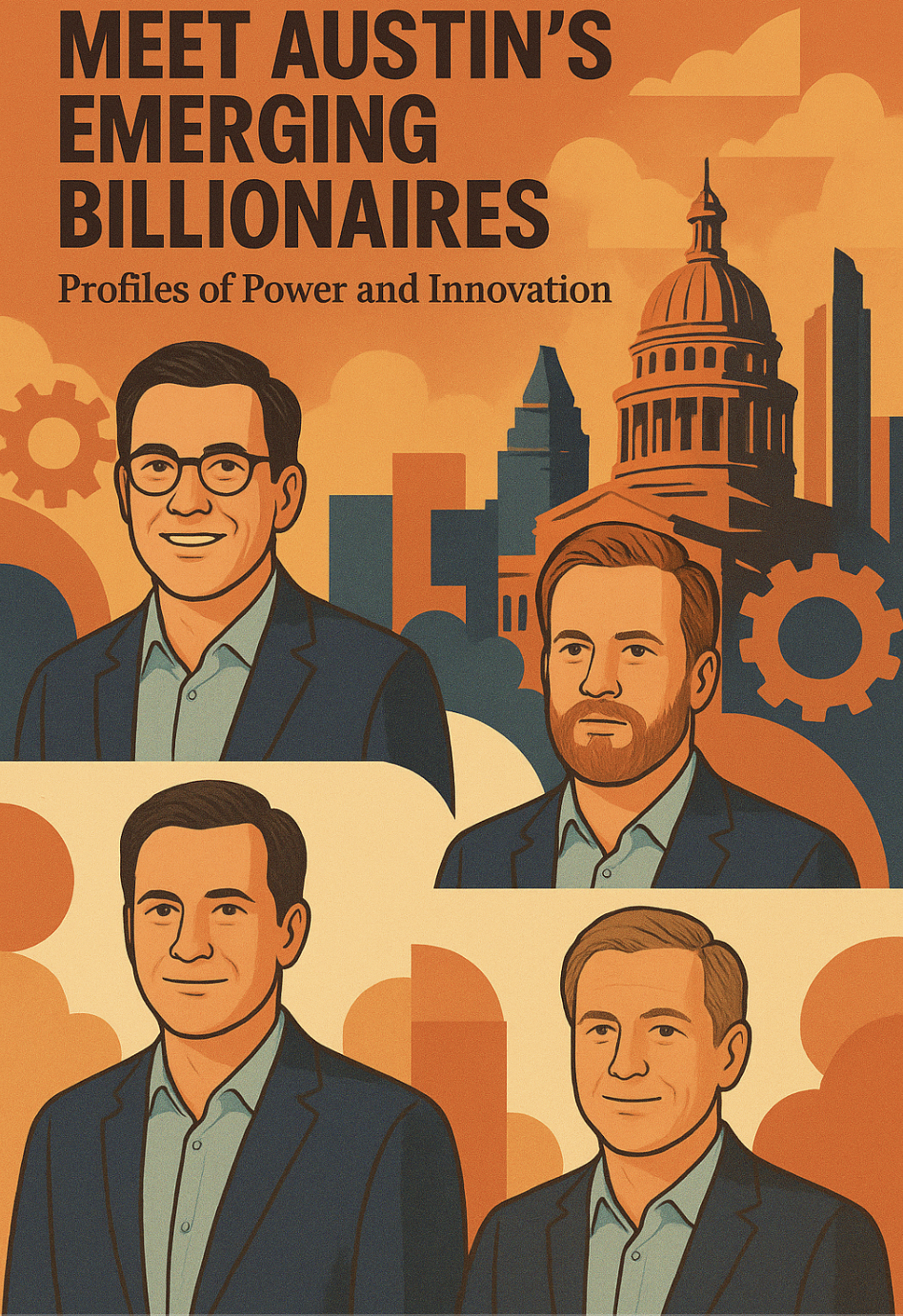
Austin has always had a reputation for attracting big thinkers, but over the last few years the city’s billionaire class has undergone a fascinating transformation. The familiar titans — figures like Elon Musk and Michael Dell — once defined the economic landscape almost single-handedly. They were the archetypes of Austin wealth: empire-scale founders whose identities were built on hardware, PCs, rockets, electric cars, and massive global operations.
But 2025 Austin tells a different story. A new generation of billionaires is emerging — not necessarily household names, but people whose influence is growing quickly in venture capital, artificial intelligence, biotech, and niche areas of software. Understanding who they are offers a glimpse into what Austin is becoming: a city where the next big bet might shape entire industries.
Take Jim Breyer, for example. Most people still associate him with Facebook’s early days or his tenure at Accel Partners, but 2025 marked something of a comeback. His stake in Circle, the company behind the USDC stablecoin, surged in value after the firm went public, returning him to the Forbes 400. What’s interesting is that Breyer isn’t just dabbling in crypto windfalls — he’s repositioning himself around AI-driven healthcare and long-horizon investments, now rooted in Austin. He’s become one of the city’s most unpredictable but intriguing financial thinkers, a veteran reinventing himself alongside the city.
Joe Lonsdale represents another flavor of this new Austin billionaire. He arrived with 8VC and quickly made the firm synonymous with the city’s boldest bets in defense tech, data infrastructure, and frontier industries. Lonsdale doesn’t exactly blend in — he’s outspoken, politically involved, and deeply committed to reshaping how capital and talent circulate through Texas. His growing wealth reflects the rise of a more aggressive, systems-level vision for what Austin’s tech ecosystem can be.
Then there’s Ben Lamm, a figure who stretches the definition of “tech entrepreneur” in ways that feel uniquely Austin. As co-founder of Colossal Biosciences, he’s leaning into the audacious idea of de-extinction — not just as a scientific curiosity, but as a vehicle for breakthrough genetic and conservation technologies. Lamm’s ascent symbolizes Austin’s accelerating foothold in biotech, an industry that once felt peripheral in a city known mainly for software.
Balancing out the futurists is Joe Liemandt, one of Austin’s more established and quietly influential billionaires. His wealth comes from software acquisition and consolidation — not exactly headline-grabbing work, but a critical part of the city’s economic backbone. Through Trilogy Software and ESW Capital, he’s built something resembling a private software empire. Liemandt represents the stabilizing force in Austin’s billionaire landscape: proof that methodical, operationally heavy businesses still thrive in a city increasingly known for moonshots.
Old vs. New Billionaires: A Shift in Power and Philosophy
What’s striking is how fundamentally different this new group is from the old-guard billionaires who put Austin on the map. Musk and Dell built companies grounded in physical products and large-scale manufacturing — industries that require enormous capital, long development cycles, and huge workforces. Their paths to wealth were tied to tangible goods and massive physical output.
By contrast, Austin’s rising billionaires tend to operate in realms where speed, intellectual capital, and digital infrastructure dominate. They build their fortunes through venture cycles, code, algorithms, and high-risk scientific research. The new class is more diversified, more experimental, and more globally interlinked. Instead of creating the physical hardware of the future, they’re coding it, funding it, editing its DNA, or predicting its direction through data.
The difference isn’t just economic — it’s philosophical. The “old guard” scaled monumental companies; the new wave scales ideas. Musk and Dell reshaped industries through force and infrastructure. Breyer, Lonsdale, Lamm, and Liemandt reshape them through investment, iteration, and experimentation. It's a transition from industrial revolutionaries to intellectual and technological architects.
What This Means for Austin
The rise of this new billionaire cohort is diversifying where money, talent, and risk-taking flow. Austin is no longer a city defined by a handful of giant companies; instead, it’s becoming a crossroads for next-gen biotech, AI, crypto-finance, and deep-tech defense. Venture firms headquartered in Austin now draw entrepreneurs from around the country. Biotech labs are planting roots. Software acquisition giants keep the mid-market thriving.
With these fortunes come ripple effects: philanthropy, university partnerships, public-private projects, and — inevitably — pressure on the real estate market. Austin’s identity is shifting alongside its wealth, and the values of this new billionaire class will shape the next decade of growth.
Final Thoughts
Austin’s billionaire story is no longer a tale of a few giant personalities. It’s a tapestry of returning legends, boundary-pushing scientists, aggressive venture capitalists, and strategic software operators. What unites them isn’t their industry — it’s their willingness to bet on the future from a city that welcomes the bold and unconventional.
As Austin continues to evolve, this new wave may prove just as influential as Musk or Dell once were. They may not always dominate headlines, but they’re quietly redrawing the map of what’s possible in “Silicon Hills.”
Recent Posts







GET MORE INFORMATION